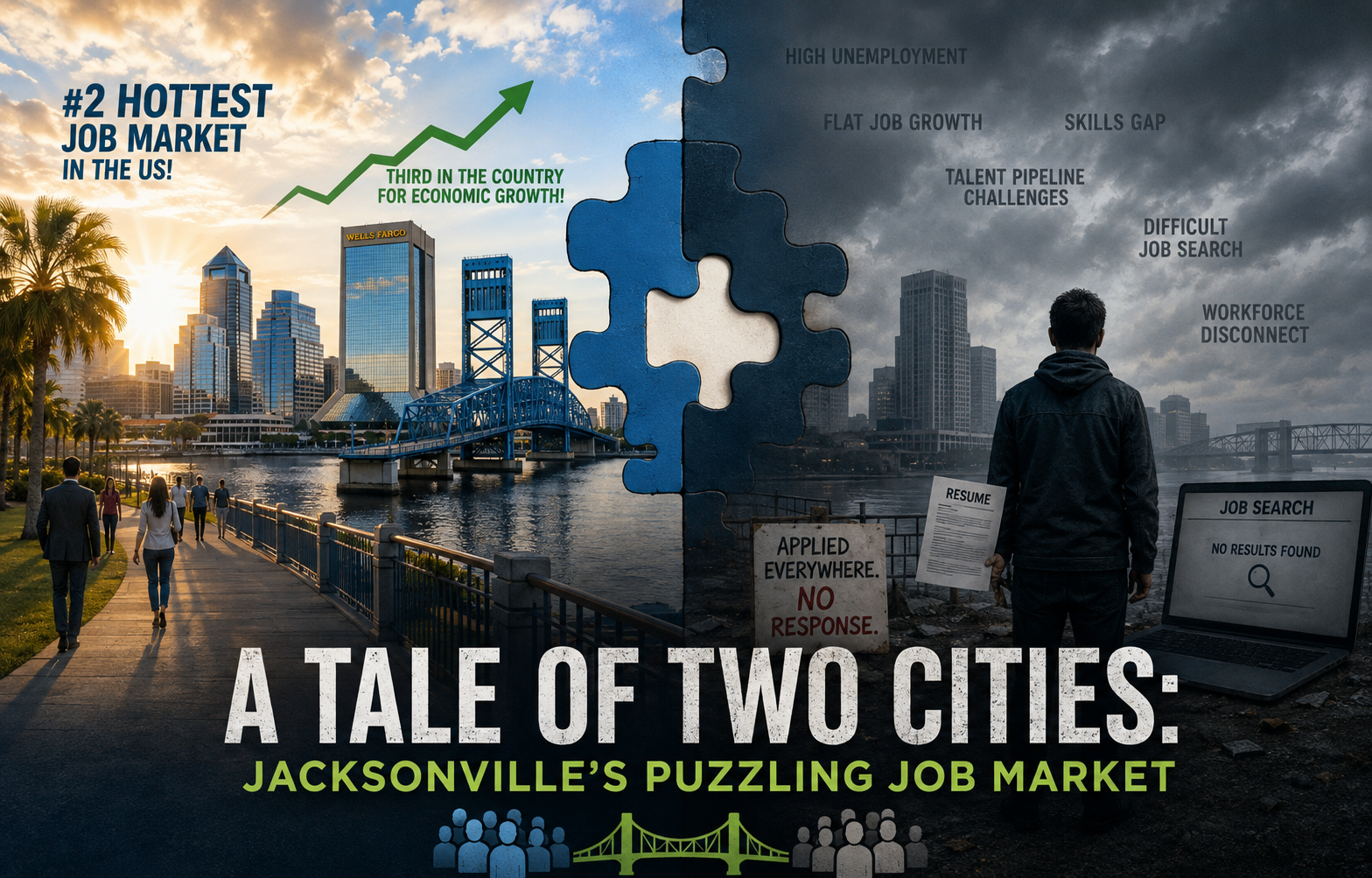
We’ve all seen the splashy headlines.
“Jacksonville is the #2 hottest job market in the US!”
“Jacksonville is third in the country for economic growth!”
Judging by the rankings, our fair city is absolutely cooking when it comes to employment. This means that job seekers should have no shortage of options when it comes to finding work, right?
Wrong. The available evidence points to a puzzle that hasn’t garnered the same level of attention as those studies trumpeting Jacksonville’s economic greatness. While we hear a lot about the city’s nation-leading labor environment, the reality facing prospective employees is a lot more complex.
While we hear a lot about the city’s nation-leading labor environment, the reality facing prospective employees is a lot more complex.
What the numbers actually say
Let’s look at some numbers to set the background. The latest figures from the Florida Department of Commerce, Bureau of Workforce Statistics and Economic Research, indicate that the current unemployment rate in Duval County is nearly 5%, up from last year and higher than the state and national averages. Unemployment has been on the rise since April 2023, when it was roughly half the current rate. However, a recent report from the Federal Reserve Bank of Atlanta finds that Jacksonville’s job market is merely following regional and national trends.
When you peer under the hood and look at where hiring has occurred locally, an interesting picture emerges. Compared to last year at this time, nonagricultural employment is up a paltry 0.3%, or 2,600 jobs out of over 800,000 in the Jacksonville Metropolitan Statistical Area (MSA). The largest and fastest gains have come in the Education and Health Services sector, which has grown at ten times the clip of jobs in Leisure and Hospitality. The biggest losses came in the Finance and Government industries.
This sectoral difference matters. Jobs in Education and Health Services are much more likely to require higher education than those in Leisure and Hospitality, and Jacksonville has the lowest percentage of college educated workers out of the major cities in Florida, according to an analysis done by State of Jax. In addition, a majority of the region’s fastest growing occupations require a bachelor’s degree.
To briefly recap, Jacksonville’s economy has a relatively high unemployment rate, almost flat employment gains, and a troubling divide between the demographics of the local talent pipeline and where hiring is predicted to be strongest over the next decade. All this in a city whose population has skyrocketed 10% in half a decade.
The other side of the equation
Now we come to the other side of the equation — job seekers. While anecdotes are not data, individual experiences can be illuminating. One of the most interesting sources of first-hand accounts on the Jacksonville job market can be found in the city’s own dedicated page on the social media website Reddit: r/jacksonville.
Virtually every week visitors will come across a desperate post from someone hard on their luck and looking for work. While it’s impossible to tell exactly how qualified these posters are to begin with, their stories paint the impression of a job market thoroughly divorced from the gaudy headlines and rankings.
Consider one submission entitled “The job market in this city is rigged.” As is customary on these kinds of posts, the author alleges to have applied for “dozens and dozens” of jobs with nary a prospect in hand. Respondents offer words of condolences and occasionally employment leads. This is a sad and very inefficient way of trying to find work in a tough market. But, like clockwork, you are likely to find posts like this one with stunning frequency. Rinse and repeat.
Two explanations for the disjuncture
There are at least a couple explanations for this odd disjuncture between the roaring economy news stations brag about and the hardships of people perpetually searching for a job in this area.
Hiring efforts are disingenuous
Organizations say they are hiring, and they post plenty of positions to support that claim, but they fail to actually onboard new employees. This sleight of hand allows them to go back to their shareholders and tout how great things are internally because they are on a hiring spree and have their pick of the litter when it comes to candidates. Some companies have even been accused of submitting “ghost” postings to popular job search boards like Indeed and Monster. The extent to which such activity is the culprit in Jacksonville remains unclear.
The talent pipeline falls short
Perhaps it is the case that organizations are legitimately hiring, but the workforce isn’t well matched to the positions posted online. It could be that candidates don’t possess the right credentials, be they a postsecondary certificate, industry certification, or college degree. It could be that job seekers are deeply flawed in some way that automatically disqualifies them for certain positions, like they have a record with multiple felonies attached. It could be that hopeful employees lack the necessary soft skills to win over the hiring authority during the interview process. Whatever the case may be, the fault lies with the job seeker, not with the entity searching for help.
“The workforce isn’t there. The average age of workers in the industry is mid-50s.”
— A Jacksonville business leader, quoted in the Atlanta Fed study
A proposal: one front door for the region
Whether the correct response resides on the demand-side or the supply-side, one thing seems abundantly clear — employers don’t fully understand the experience of job seekers, and potential employees don’t necessarily know how to find real, good jobs for which they are qualified. Recognizing the chasm between hiring intentions and job placement results, I propose the development of a freely available, widely publicized central clearinghouse for all jobs in the region coupled with an investment in what John Everett calls “Jacksonville’s human infrastructure.” Here’s what this might entail.
Hiring officers at organizations large and small would submit their postings to an online platform hosted by a regional governance association like the Northeast Florida Regional Council or local workforce board like CareerSource Northeast Florida. Job seekers would meet with career counselors who would assess their employment prospects, discuss goals, and create validated profiles that would automatically match candidates with positions aligned with their skills and experience. Perceived deficits in employability would be met with action plans that identify high-value upskilling opportunities like apprenticeships and credentials, offer information about financial assistance, provide referrals to career coaches, recommend affordable childcare services, and even distribute vouchers redeemable for free interview attire from participating stores. Emails would be sent out to all job seekers who fit the bill for a given position, instantly inviting them to interview. No fake postings. No dubious resumes. Think of it like LinkedIn for Northeast Florida with quality control.
Think of it like LinkedIn for Northeast Florida with quality control.
Something is rotten in the state of our job market. It is somehow both among the best in the country and struggling to fulfill the needs of employers and job seekers alike. As is often the case, the truth lies somewhere in between. If Jacksonville and its surrounding areas truly want to resolve this discrepancy, it will require investing heavily in closing the gap between the stated preferences of those hiring and those swimming through a murky labor pool. Only through sustained investment in our people and the systems that connect them can we translate those celebrated accolades into real outcomes worth cheering about.