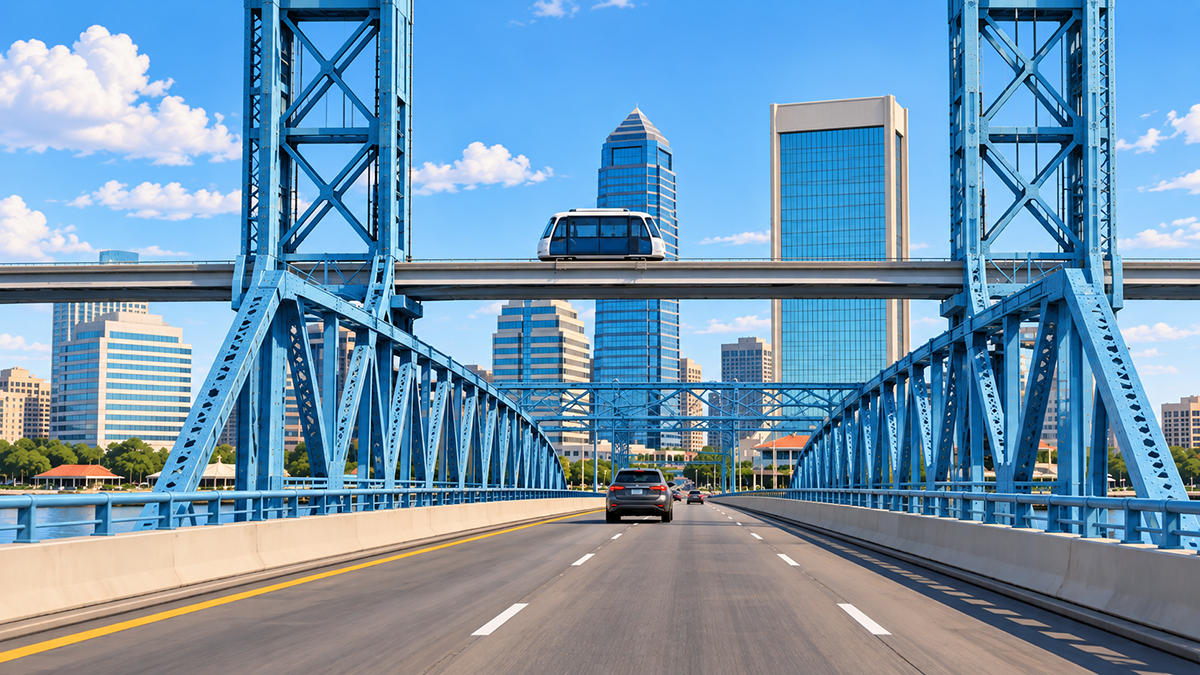
Jacksonville wants to be counted among the world’s great cities. Josh Gellers argues that getting there depends on something far more basic than rankings: whether the people who power our economy can actually get to work.
Recently I attended a conference at Georgia Tech in Atlanta. In order to keep my trip economical, I decided to arrive by plane on the day of my panel discussion. A lot needed to go right in order to pull this off—the flight had to be on time and I had to arrive at the conference venue with just enough time to change into my suit, get something to eat, and catch my breath.
Fortunately, upon my arrival into Hartsfield-Jackson Atlanta International Airport, I found my way to MARTA—the metro area’s public transit system. For $2.50, I was able to venture from the airport to the doorstep of the conference hotel in a mere 35 minutes.
I was relieved that, thanks to Atlanta’s robust public transportation network, I had a speedy and smooth transition to my final destination, with plenty of time to spare before my event.
This experience made me think about the importance of public transportation to the vitality of Jacksonville’s economy. It is perhaps the worst-kept local secret that Jacksonville is the largest city by landmass in the continental United States (only four cities in Alaska are greater in size). Such an enormous expanse comes with its own set of challenges, not least of which is facilitating the movement of people from their homes to their places of work.
When the Jobs Are Out of Reach
It turns out that this unique situation holds major implications for the city’s economic potential. Here is the issue—if people cannot travel to where the jobs are in a reasonable amount of time, it will stifle hiring, productivity, and, ultimately, economic growth.
Absent a well-oiled public transportation system, workers will be heavily dependent on cars. That is not necessarily problematic, unless the very workers who need to drive long distances to find work cannot afford to own and maintain an automobile.
Yet, in a city where the average hourly wage lags the national average while the price of car ownership hovers around $1,000 per month, you have the recipe for severely limited labor mobility. This isn’t good for anyone.
A 2021 study from the Center for Transportation Studies at the University of Minnesota presents startling data that clearly exposes the gravity of Jacksonville’s situation.
Out of 50 large cities analyzed, Duval ranked 49th in terms of job accessibility.
For context, Atlanta boasted twice the number of jobs reachable by transit within 30 and 60 minutes compared to Jacksonville.
In our city, jobs tend to be concentrated around several major employment centers, including downtown, Southside, the port, Arlington, and the beaches. If you live more than 30 minutes from any of those areas and rely on public transportation, your ability to find and hold a job will be significantly hampered.
A City With Global Ambitions
The stakes of relatively poor job accessibility run high. Jacksonville is a city that aspires to join the ranks of the world’s best municipalities.
In the most recent Global Cities Index from Oxford Economics, Duval earned the distinction of being named a top 5 North American city to watch. This accolade suggests Jacksonville is trending in the right direction.
Jax365, a program of the Jacksonville Civic Council, has set an ambitious goal of elevating Jacksonville to a top 50 global city by 2032. We should welcome such visionary striving and set a course to reach this lofty objective.
Moving in the Wrong Direction
At the same time, our public transportation system is currently a drag on that laudable pursuit.
In the face of financial insolvency and leadership uncertainty, the Jacksonville Transportation Authority (JTA) is laying off employees, cutting back on bus services, and retreating from innovative-yet-underperforming transit solutions like the Skyway and NAVI.
In other words, at a time when public transportation is absolutely crucial to our city’s economic future, its availability is actively being scaled back.
The cost of car ownership is not likely to go down any time soon.
Average wages in the city are also not likely to rise significantly in the near term.
Municipal tax revenue that supports mass transit will likely be reduced severely in light of Amendment 3’s passage.
Only One Way Forward
Given these realities, there seems to be only one way forward—we need JTA to be turned around and our transportation infrastructure to be expanded dramatically.
Whether you are an employer or a job seeker in Jacksonville, the fate of our local economy depends on the ability of workers to be able to get to where the good paying jobs are clustered. Accomplishing this basic but important public service will require a major upgrade to our mass transit system.
Continuing to repave roadways and widen highways won’t get us to the promised land.
It Takes More Than Laying Track
Crucially, getting our city’s workforce moving will require an all-hands-on-deck approach. This means thinking beyond traffic planning and laying track.
In addition, we need to cultivate an ecosystem of supportive roles trained in a variety of fields, including construction management, leadership, logistics, and project management.
The mental and physical labor necessary to dream up and build a better mass transit system must be complemented by a steady supply of professionals equipped with a combination of sector-specific knowledge and managerial skills.
Where the Rubber Meets the Road
If Jacksonville truly wants to become a top global city, we need to focus on where the rubber meets the road, and invest in the talent and training essential for executing a bold new vision for labor mobility, one that strives for more than merely moving people efficiently from point A to point B.
That distance is especially far apart in Duval, but we can close that gap if we address it intentionally.