
If you run a local business with a sales team, you've probably set a team goal before — one number, everyone rowing toward it together. It feels collaborative. It feels fair. And it often quietly fails, not because the team doesn't work hard, but because of something deeper: when everyone owns a number, no one truly owns it.
Shared Goals Feel Good, But Diffuse Responsibility
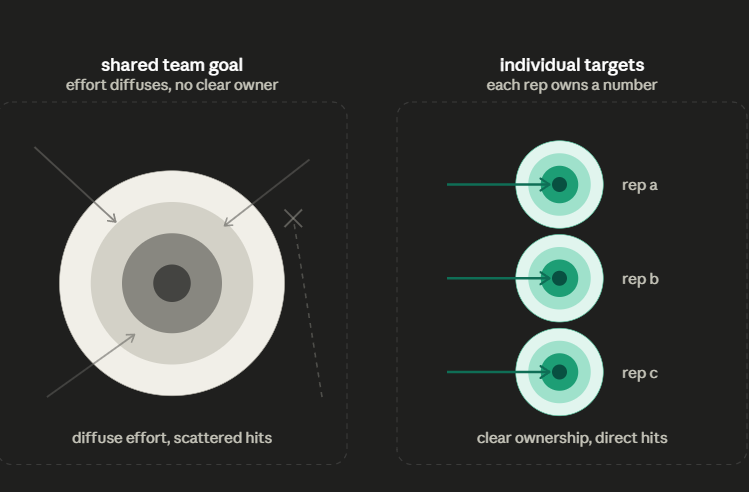
You've likely heard the saying that when everything is important nothing is important; well in sales, if everyone owns the target no one owns the target. There's a well-documented human tendency: the more people who share responsibility for an outcome, the less any one person feels personally responsible for it. In a sales team, this shows up quietly. A rep has a slow week and thinks, someone else will make up the difference. Another rep sees the team is "roughly on track" and eases off, because the pressure isn't pointed at them specifically — it's pointed at "the team."
No one is being lazy or dishonest here. This is just how shared ownership works. A team goal is real, but it's abstract. An individual target is personal — and personal is what drives behavior.
A Number With Your Name On It Changes the Relationship to the Work
When a rep has their own target, the question shifts from "How's the team doing?" to "Am I on pace?" That's a much harder question to avoid, and a much easier one to act on. It converts a vague sense of collective effort into a specific, personal commitment. It also helps drive competition in a sales team to have their name at the top of the list.
This isn't about pressure for its own sake. It's about clarity. A salesperson who knows exactly what "good" looks like for them — not for the team in aggregate — has something concrete to measure themselves against every single day. Ambiguity is the enemy of performance; a shared number is inherently ambiguous about what any one person should actually be doing today.
Individual Targets Reveal What Averages Hide
A blended team number can look perfectly healthy while masking real problems underneath. One rep might be significantly outperforming, quietly propping up the average while another coasts unnoticed. From the outside, "we hit our number" — but that's a fragile kind of success. It depends on your best performer continuing to overperform indefinitely (many times unnoticed), and it teaches your weaker performers that their individual contribution doesn't really matter.
Individual targets make performance visible at the level where coaching and recognition actually need to happen — with the person, not the pool.
Targets Should Be Set With People, Not Just Handed to Them
There's an important distinction between an individual target that's assigned and one that's owned. A number handed down from above, with no input from the person expected to hit it, can feel arbitrary — something to negotiate down or quietly resent. A target a rep helped shape, based on their own book of business, territory, and stage of development, is different. It becomes their number, not just a number applied to them.
This is really the philosophical core of the whole approach: accountability doesn't come from a target existing. It comes from a person believing the target is theirs — fair, specific, and something they had a hand in setting. That belief is what turns a number on a whiteboard into a personal commitment.
The Underlying Principle
Individual targets work not because they add pressure, but because they restore ownership. They take something diffuse — "the team's performance" — and turn it into something personal — "my performance." And people consistently show up more fully for the things they feel personally responsible for than for the things they merely share in.
A team can still function as a team — supporting each other, sharing knowledge, covering for one another in a pinch. But underneath that collaboration, each person should be able to answer, without hesitation, exactly what success looks like for them this month. That clarity is what individual targets provide, and it's a foundation no team-wide number can replace on its own.
Accountability doesn't come from a target existing. It comes from a person believing the target is theirs.