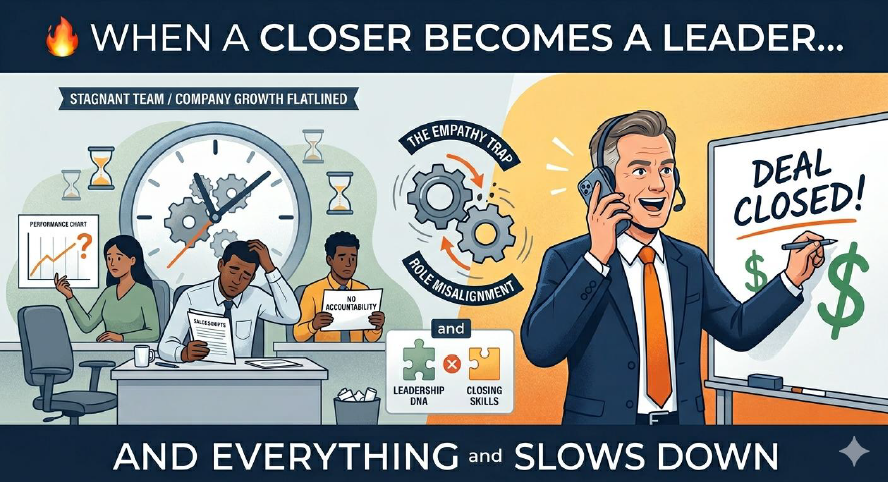
In the journey of growing small to mid-sized businesses, there's a common story that unfolds: the "star performer" who unintentionally becomes a roadblock in the organization's advancement. This scenario often emerges in consultations with businesses navigating the complexities of leadership transitions and promotions, underscoring the significant risks tied to advancing high-performing individuals into positions that may not align with their skill sets. It's a stark reminder: identifying leadership misalignments is not just an HR issue — it's a critical strategic necessity.
The central character of this narrative is a high-achieving individual who excelled as a top-tier closer within a large corporation. After years of significant contributions, they transitioned to a pivotal leadership role, aiming to drive sales across the company. Initially, they brought impressive results by personally closing complex deals and earning equity through exceptional performance. However, translating their individual success into team-wide achievements has proven challenging.
The Accountability Gap
Over the past few years, despite their expertise and initial successes, the company's growth curve has flattened, revealing the gap between individual brilliance and leadership effectiveness. An objective Sales DNA assessment highlighted an "accountability gap" in their leadership style. Scoring critically low in the "Responsibility" category, a pattern of attributing business challenges to external market conditions rather than internal strategies took shape. This was coupled with a deficiency in the "figure it out" mindset, crucial in entrepreneurial settings where adaptability and self-reliance are paramount.
The Empathy Trap
This misalignment resulted in an internal struggle where leadership processes went unestablished, leading to a breakdown in departmental structures and team dynamics. The transition from high performer to an empathetic leader inadvertently created an "Empathy Trap," where managers, too understanding of their team's challenges, hesitated to enforce accountability. Essential management activities like weekly one-on-ones and structured Performance Improvement Plans were notably absent.
Leadership processes went unestablished, causing breakdowns in departmental structures.
Weekly one-on-ones and performance check-ins were consistently absent.
Structured Performance Improvement Plans were never implemented.
Team dynamics deteriorated as accountability consistently went unenforced.
The Strategic Impasse
The company faced a strategic impasse, where leadership roles and titles clashed with actual business needs. Attempts to realign roles to capitalize on the individual's elite skills as a closer were met with resistance. This deep-rooted attachment to the leadership title effectively placed the company in a difficult position, where executive leaders needed to step back into operational roles that were supposed to be managed by the sales director.
How to Avoid This Trap
Prioritize Strategic Alignment Over Loyalty: Personal loyalty cannot replace the need for strategic alignment. Advancing high performers without considering their natural fit for leadership roles can stall growth and innovation.
Leverage Diagnostic Tools: Avoid hiring by résumé and past performance alone. Instead, leverage diagnostic tools and frameworks to assess leadership capabilities objectively. By doing so, businesses can overcome biases and ensure alignment between roles and individual aptitudes.
Apply the GWC Framework: In EOS it's called GWC — you can have someone that Wants it and has the Capacity to do it; however, do they Get it? Aligning leadership DNA with the evolving demands of business growth is the sole sustainable pathway to expansion.
Aligning leadership DNA with the evolving demands of business growth is the sole sustainable pathway to expansion.